

Starting the server
~/.fabro/fabro.sock by default. Use --bind 127.0.0.1 for TCP.
First run: web install wizard
If~/.fabro/settings.toml does not yet exist, fabro server start enters install mode: it prints an install URL and a one-time install token, attempts to open the URL in your default browser, and serves a web wizard that walks you through configuring your server URL, shared object store, LLM provider, and GitHub integration.
The LLM step can be completed with one or more provider keys, or explicitly skipped so you can finish server setup first and add model credentials later. A skipped LLM step writes no LLM vault credentials; LLM-dependent workflows keep failing with provider-not-configured errors until credentials are added. Optional integration secrets collected by install mode, including LLM keys and GitHub App secrets, are written to the server vault rather than server.env.
When Fabro can construct a direct install URL, the token is embedded in the URL and also printed on its own line for copying. If you open the server root through a reverse proxy or another machine, paste the printed install token when prompted.
The Object store step offers two wizard-managed modes:
Local diskfor a host-local object-store root, detected by default and editable before continuingAWS S3for one shared bucket with fixedslatedb/andartifacts/prefixes
AWS_ACCESS_KEY_ID and AWS_SECRET_ACCESS_KEY in server.env. It does not collect STS/session tokens or S3-compatible endpoint settings. If you need MinIO, Cloudflare R2, path-style options, or custom endpoints, finish install with local defaults and then edit [server.slatedb] / [server.artifacts] in settings.toml manually.
When you finish the wizard, the server writes ~/.fabro/settings.toml and exits cleanly. Start it again to boot in configured mode:
restart: unless-stopped, systemd, or Railway’s restart-on-exit) this second start happens automatically.
For headless or scripted environments where no browser is available, run fabro install instead — it’s the same wizard as a CLI prompt flow.
Common flags:
See Server Configuration for the full
settings.toml reference.
SQLite blob storage activation
On startup, Fabro activates SQLite as the only live content-addressed blob store before it opens routes, schedulers, workers, webhooks, reapers, or the ready callback. The activation inventories the exact legacy SlateDB blob prefix and run history, then checks disk headroom for the rows not yet imported, any required blob backup, and the projected post-import database snapshot required by run-history activation. A warm restart with no pending imports or backups only needs a small fixed headroom; on filesystems whose free space cannot be determined the check is skipped with a warning. Fabro then imports in bounded transactions, compares every legacy blob byte-for-byte with SQLite, runs a live SQLite integrity check, and attempts a final WAL truncate checkpoint. A busy final truncate logs a warning and startup continues so a later checkpoint can finish after the blocking reader exits. Boots that import new rows additionally re-verify every legacy blob against SQLite and validate every SQLite blob row independently. Any failure stops startup. Warm boots that import no rows skip that full target scan: the import pass has already byte-compared every retained legacy row, and SQLite-only blobs are hash-validated when read. Rows committed by an interrupted import are retained so the next startup can resume, but the legacy source is never modified and there is no fallback or dual read/write path. For a non-empty legacy inventory, the first activation also creates the private sibling backupfabro.sqlite3.pre-blob-activation.bak. Fabro writes the staging database
inside a private same-directory area, applies owner-only permissions, flushes
and validates it, then publishes the backup without overwriting an existing file.
A valid retained backup is revalidated on every warm restart and is preserved
as the original pre-activation safety artifact. If any legacy row is already
present in SQLite, a missing retained backup stops startup rather than silently
moving that rollback boundary forward. It is not a promise that an
older binary can safely resume after the activated server has accepted new
work; recovery after that boundary is forward-only. Empty legacy inventories
do not need this backup.
Keep both the unchanged legacy blobs/sha256 prefix and the private activation
backup for at least 30 consecutive calendar days after the first successful
production activation. Cleanup is eligible only after a successful cold
activation, a later warm restart that revalidates the backup and byte-compares
every retained legacy blob against SQLite, and 30 days of production observation
with no unresolved inventory, import, verification, integrity, backup, or
checkpoint failure. Scott must review that evidence and explicitly authorize a
separate cleanup change. Day 30 is only the earliest eligibility date; nothing
is deleted automatically, and incomplete evidence extends the support window.
SQLite run-history activation
Immediately after blob activation, and still before routes, schedulers, workers, webhooks, reapers, or readiness are exposed, Fabro activates SQLite as the sole authority for run existence, run events, and each run’s current projected row. The activation strictly validates and fingerprints the exact legacy SlateDB run-event key/value stream, imports each complete run in its own transaction, verifies every legacy history as an exact SQLite prefix, replays and verifies every SQLite run independently, and runs a full SQLite integrity check. It attempts a final WAL truncate checkpoint, but a blocking reader only produces a warning because committed activation data remains durable in the WAL. A source fingerprint or count change after activation stops startup. There is no fallback or dual-read/write mode. For a non-empty legacy run history, the first activation creates and validates the private sibling backupfabro.sqlite3.pre-run-history-activation.bak before importing anything. The
backup is published without overwriting an existing file and is revalidated
on every restart. If import progress exists but that retained backup is
missing, startup stops. An empty legacy source is accepted without a backup
only when SQLite also has no unmarked run data. The activation marker stores
the source identity and first-success timestamp; retries preserve that
timestamp and repeat source, destination, backup, and integrity checks.
After activation, creating a run commits run.created, the run’s current row,
and its existence atomically. Later appends update the event log and current
row in one transaction, and live streams advance only after commit. Deleting
a migrated run commits a tombstone with the SQL deletion so the retained
legacy source cannot resurrect it during a restart.
Keep the unchanged legacy runs/*/events/* data and the private activation
backup for at least 30 consecutive calendar days after the persisted
first-success timestamp. Cleanup also requires successful cold and warm
activation evidence, production observation, backup and restore validation,
deletion/restart coverage, and explicit approval for a separate cleanup
change. Nothing is deleted automatically. The run-history activation backup
represents the database immediately before run-history import and can be used
to retry or recover the activation with a binary that knows the activated
schema. It is not a binary-downgrade artifact because it already contains the
new SQL migrations.
To return to the older binary, stop the server and restore the database’s
.pre-migration.bak snapshot instead, then remove any -wal and -shm
siblings before starting the older binary. That snapshot was taken before the
new migrations were applied. Either recovery path loses writes accepted after
its snapshot, so make the rollback boundary explicit before restoring it.
Submitting runs
Register the workflow content, create a run from that version, then request execution. This example uses a clone-based default environment and an empty workspace target; add the authentication headers required by your server:runnable runs to running in FIFO order, up to the concurrency limit. Parent-generated child runs can remain pending until a user approves them.
Run lifecycle
- Submit —
POST /api/v1/runscreates the run with statussubmitted. - Start request —
POST /api/v1/runs/{id}/startmakes normal runsrunnable; parent-generated child runs may becomependingwithapproval_required. - Approve if needed — Approving a pending child run makes it
runnable; denying it fails withapproval_denied. - Schedule — The scheduler picks up
runnableruns up tomax_concurrent_runs. - Execute — The engine walks the graph, streaming events to all subscribers.
- Complete — The run transitions to
succeeded,failed, ordead.
Web UI
The web UI connects to the API server and provides:- Runs board — Monitor all active runs organized by status
- Run detail — Real-time stage progress, event stream, diffs, and usage stats
- Files Changed — Browse changed files with a searchable tree, per-file status, aggregate diff stats, and split or stacked diffs
- Settings — Inspect server configuration, enabled integrations, storage, auth, and capacity settings
- Start new run — Submit workflows from the browser
- Human-in-the-loop — Answer agent questions through the web interface
- Workflows — Browse available workflows, view their graphs, and see run history
- Insights — SQL-based analysis across runs via DuckDB
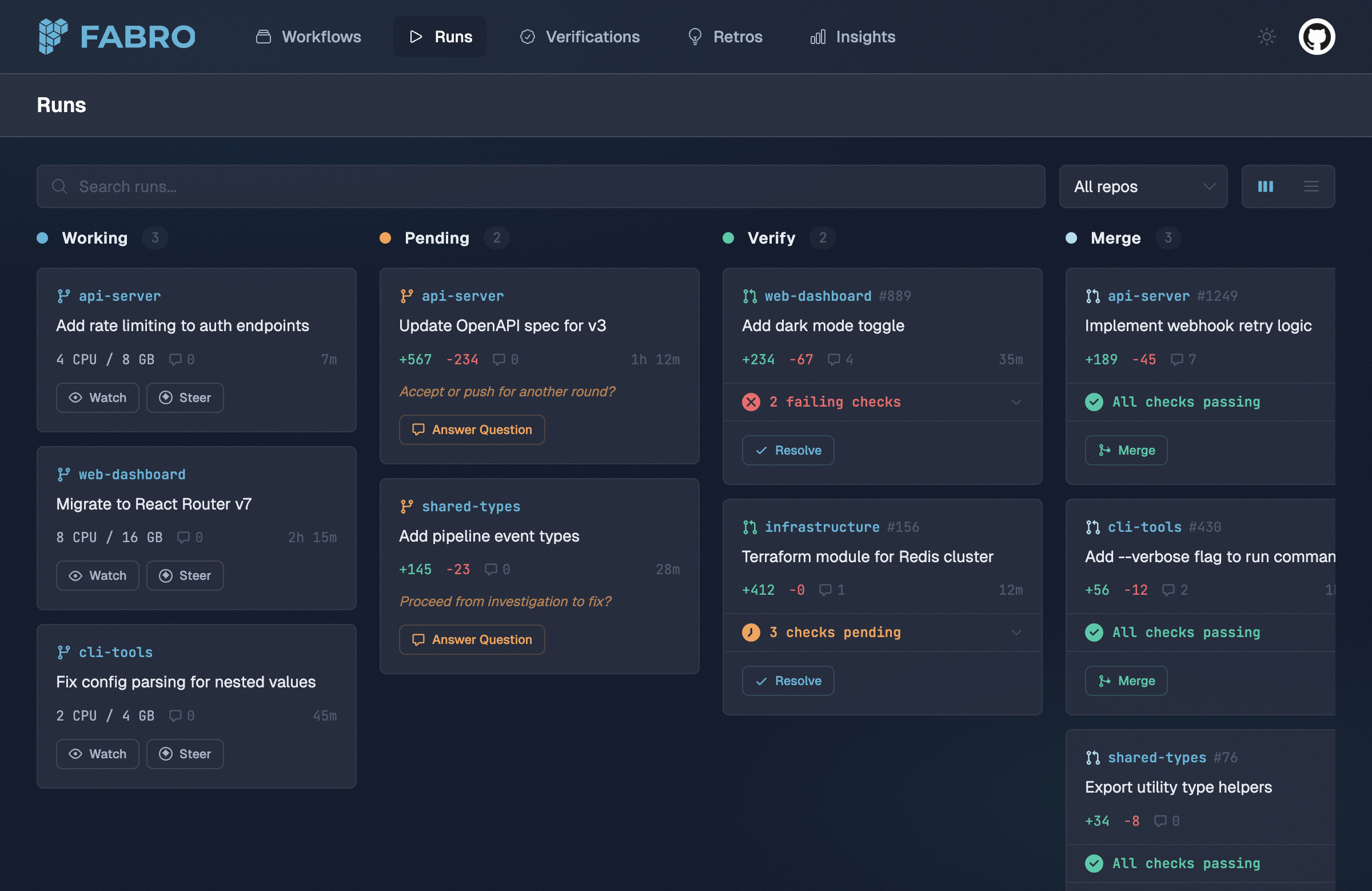
The Runs board shows all active runs organized by status.
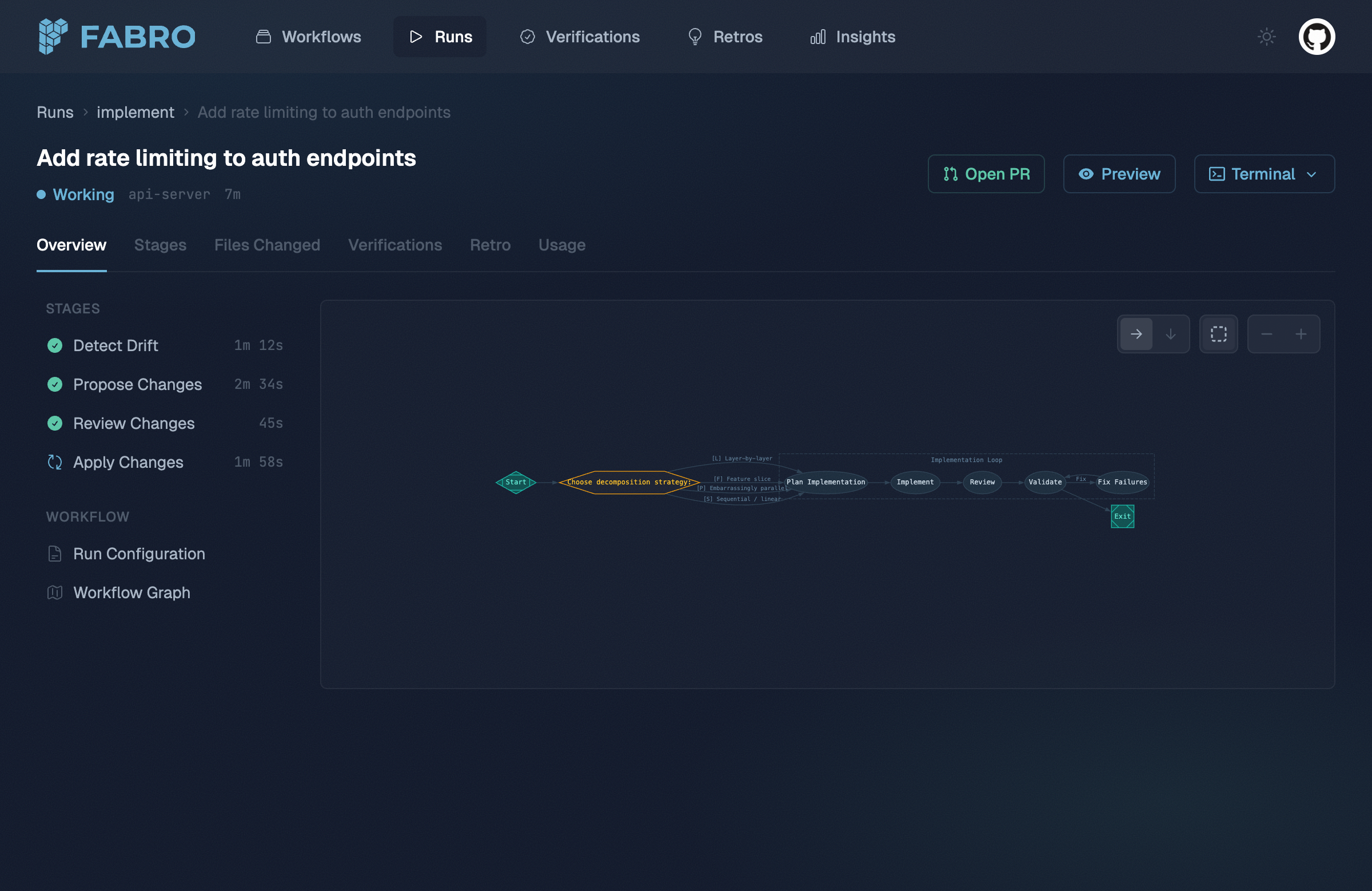
The run detail view shows stage progress alongside the workflow graph.
Event streaming
The API streams run events via Server-Sent Events (SSE). Every stage start, LLM call, tool invocation, and edge selection is emitted as a structured JSON event. Any HTTP client that supports SSE can subscribe — the web UI is just one consumer.Human-in-the-loop
Human-in-the-loop questions are served over HTTP. The engine blocks the current stage until an answer is submitted, then continues execution. See the list questions and submit answer API reference pages.Authentication
The server configures auth withserver.auth.methods:
dev-token— Operators can call the API directly withAuthorization: Bearer fabro_dev_..., and the web login page can accept the dev token too.github— End users sign in through GitHub OAuth and receive a browser session cookie.
settings.toml
Demo mode
Send theX-Fabro-Demo: 1 header on any API request to get static mock data. To enable demo mode in the web UI, set the fabro-demo=1 cookie in your browser devtools (Application → Cookies). This lets you explore the UI without API keys or real workflow execution.
Pointing the CLI at a server
The CLI can target a running Fabro server for commands that support a remote API. Configure~/.fabro/settings.toml:
settings.toml
--server flag:
fabro model list and fabro model test honor [cli.target] by default unless you explicitly pass --storage-dir. fabro exec remains a local agent session and only uses the server when you pass --server.
See User Configuration for the full connection options, including client certificates for proxy-terminated HTTPS endpoints.
Next steps
Deployment
Choose where the server runs: laptop or self-hosted Docker container.
Server Configuration
Full settings.toml reference — authentication, reverse-proxy TLS, run defaults, and more.
API Reference
REST API for submitting runs, streaming events, and managing resources.
How Fabro Works
The workflow engine and architecture.