> ## Documentation Index
> Fetch the complete documentation index at: https://docs.fabro.sh/llms.txt
> Use this file to discover all available pages before exploring further.
# Workflows
> Core workflow concepts in Fabro
A workflow is a directed graph that defines a repeatable process for AI agents, shell commands, and human decisions. Unlike a DAG (directed acyclic graph), a Fabro workflow can and often does include loops — for example, implement-test-fix cycles that repeat until tests pass. You write workflows in [Graphviz DOT](/reference/dot-language), check them into version control, and run them with `fabro run`.
## Anatomy of a workflow
Every workflow is a `digraph` with a `goal`, a `start` node, an `exit` node, and one or more processing nodes connected by edges:
 ```dot title="my-workflow.fabro" theme={"languages":{"custom":["/languages/dot.json","/languages/fabro.json"]}}
digraph MyWorkflow {
graph [goal="Describe the project"]
rankdir=LR
start [shape=Mdiamond, label="Start"]
exit [shape=Msquare, label="Exit"]
scan [label="Scan Files", shape=parallelogram, script="find . -maxdepth 2 -type f | head -30"]
analyze [label="Analyze", prompt="Review the file listing. Summarize the project structure.", shape=tab]
start -> scan -> analyze -> exit
}
```
The `goal` attribute describes what the workflow accomplishes. Fabro uses it to guide agent behavior.
## Key node types
Each node's Graphviz **shape** determines how it executes. The three most important types are:
**Agents** (default `box` shape) run an LLM with access to tools — bash, file editing, sub-agents — looping autonomously until the task is complete:
```dot theme={"languages":{"custom":["/languages/dot.json","/languages/fabro.json"]}}
implement [label="Implement", prompt="Read plan.md and implement every step."]
```
**Commands** (`parallelogram`) run shell scripts and capture output for downstream nodes:
```dot theme={"languages":{"custom":["/languages/dot.json","/languages/fabro.json"]}}
validate [label="Run Tests", shape=parallelogram, script="cargo test 2>&1 || true"]
```
**Human gates** (`hexagon`) pause the workflow and wait for a person to choose a path. Edge labels define the options:
```dot theme={"languages":{"custom":["/languages/dot.json","/languages/fabro.json"]}}
approve [shape=hexagon, label="Approve Plan"]
approve -> implement [label="[A] Approve"]
approve -> plan [label="[R] Revise"]
```
Fabro supports additional node types for one-shot prompts, conditional branching, parallel fan-out/fan-in, and more. See [Stages and Nodes](/workflows/stages-and-nodes) for the full reference.
## Branching and loops
```dot title="my-workflow.fabro" theme={"languages":{"custom":["/languages/dot.json","/languages/fabro.json"]}}
digraph MyWorkflow {
graph [goal="Describe the project"]
rankdir=LR
start [shape=Mdiamond, label="Start"]
exit [shape=Msquare, label="Exit"]
scan [label="Scan Files", shape=parallelogram, script="find . -maxdepth 2 -type f | head -30"]
analyze [label="Analyze", prompt="Review the file listing. Summarize the project structure.", shape=tab]
start -> scan -> analyze -> exit
}
```
The `goal` attribute describes what the workflow accomplishes. Fabro uses it to guide agent behavior.
## Key node types
Each node's Graphviz **shape** determines how it executes. The three most important types are:
**Agents** (default `box` shape) run an LLM with access to tools — bash, file editing, sub-agents — looping autonomously until the task is complete:
```dot theme={"languages":{"custom":["/languages/dot.json","/languages/fabro.json"]}}
implement [label="Implement", prompt="Read plan.md and implement every step."]
```
**Commands** (`parallelogram`) run shell scripts and capture output for downstream nodes:
```dot theme={"languages":{"custom":["/languages/dot.json","/languages/fabro.json"]}}
validate [label="Run Tests", shape=parallelogram, script="cargo test 2>&1 || true"]
```
**Human gates** (`hexagon`) pause the workflow and wait for a person to choose a path. Edge labels define the options:
```dot theme={"languages":{"custom":["/languages/dot.json","/languages/fabro.json"]}}
approve [shape=hexagon, label="Approve Plan"]
approve -> implement [label="[A] Approve"]
approve -> plan [label="[R] Revise"]
```
Fabro supports additional node types for one-shot prompts, conditional branching, parallel fan-out/fan-in, and more. See [Stages and Nodes](/workflows/stages-and-nodes) for the full reference.
## Branching and loops
 Edges can have **conditions** that route execution based on outcomes:
```dot theme={"languages":{"custom":["/languages/dot.json","/languages/fabro.json"]}}
gate [shape=diamond, label="Tests passing?"]
gate -> exit [label="Pass", condition="outcome=succeeded"]
gate -> implement [label="Fix"]
```
Loops are natural — just point an edge back to an earlier node. Use `max_visits` on a node to prevent infinite loops:
```dot theme={"languages":{"custom":["/languages/dot.json","/languages/fabro.json"]}}
fix [label="Fix Failures", prompt="Fix the failing tests.", max_visits=3]
```
## Parallel execution
Edges can have **conditions** that route execution based on outcomes:
```dot theme={"languages":{"custom":["/languages/dot.json","/languages/fabro.json"]}}
gate [shape=diamond, label="Tests passing?"]
gate -> exit [label="Pass", condition="outcome=succeeded"]
gate -> implement [label="Fix"]
```
Loops are natural — just point an edge back to an earlier node. Use `max_visits` on a node to prevent infinite loops:
```dot theme={"languages":{"custom":["/languages/dot.json","/languages/fabro.json"]}}
fix [label="Fix Failures", prompt="Fix the failing tests.", max_visits=3]
```
## Parallel execution
 Fan out to run branches concurrently, then merge the results:
```dot theme={"languages":{"custom":["/languages/dot.json","/languages/fabro.json"]}}
fork [label="Fan Out", shape=component]
merge [label="Merge", shape=tripleoctagon]
fork -> security
fork -> architecture
fork -> quality
security -> merge
architecture -> merge
quality -> merge
merge -> report -> exit
```
## Goal gates
Mark critical nodes with `goal_gate=true`. The workflow fails if any goal gate doesn't succeed — even if execution reaches the exit node:
```dot theme={"languages":{"custom":["/languages/dot.json","/languages/fabro.json"]}}
validate [label="Validate", prompt="Run the test suite and verify all tests pass.", goal_gate=true]
```
## Running a workflow
From the CLI:
```bash theme={"languages":{"custom":["/languages/dot.json","/languages/fabro.json"]}}
fabro run workflow.fabro
```
Or from a [run config TOML](/execution/run-configuration) for repeatable, parameterized runs:
```bash theme={"languages":{"custom":["/languages/dot.json","/languages/fabro.json"]}}
fabro run run.toml
```
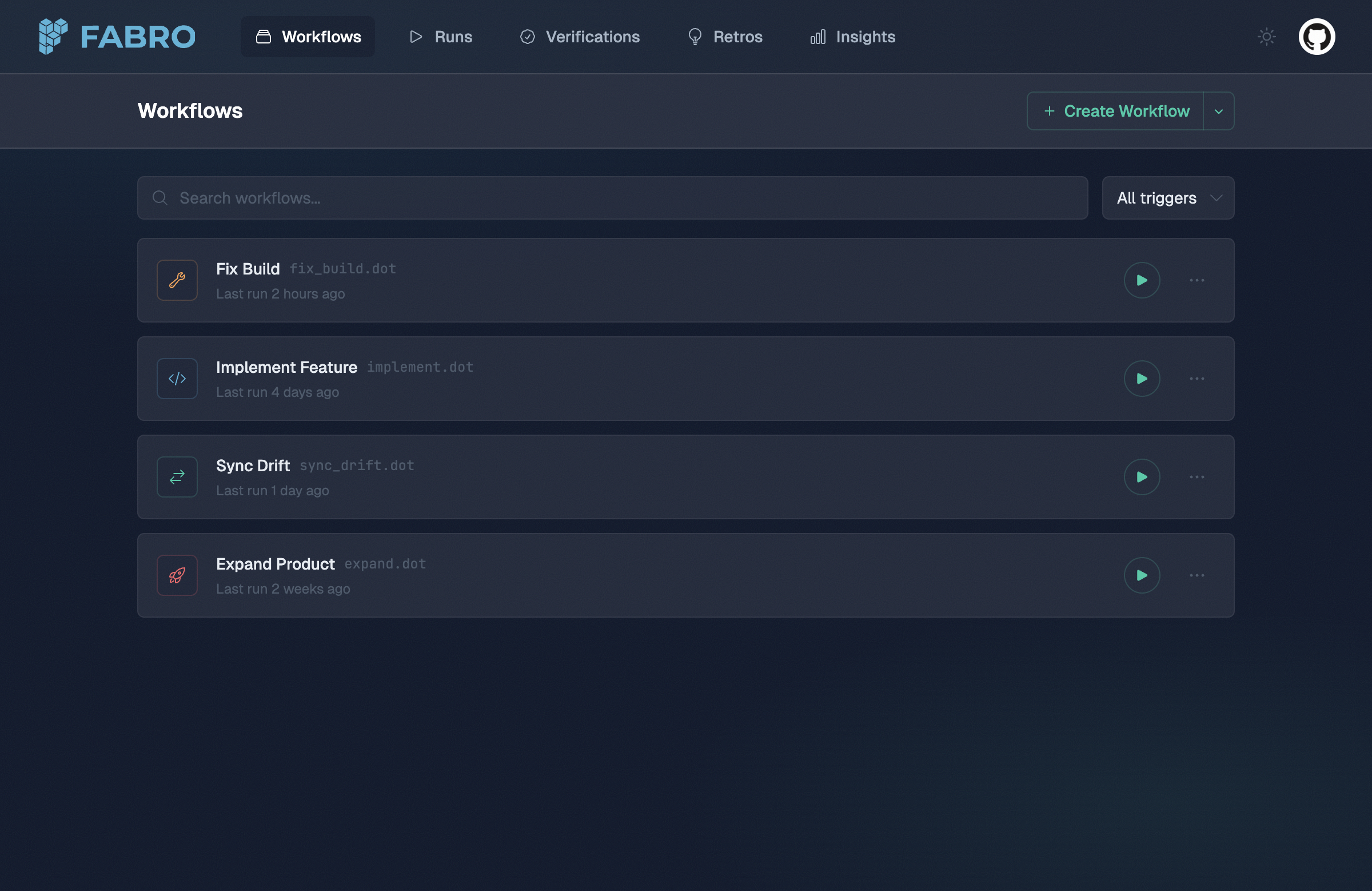
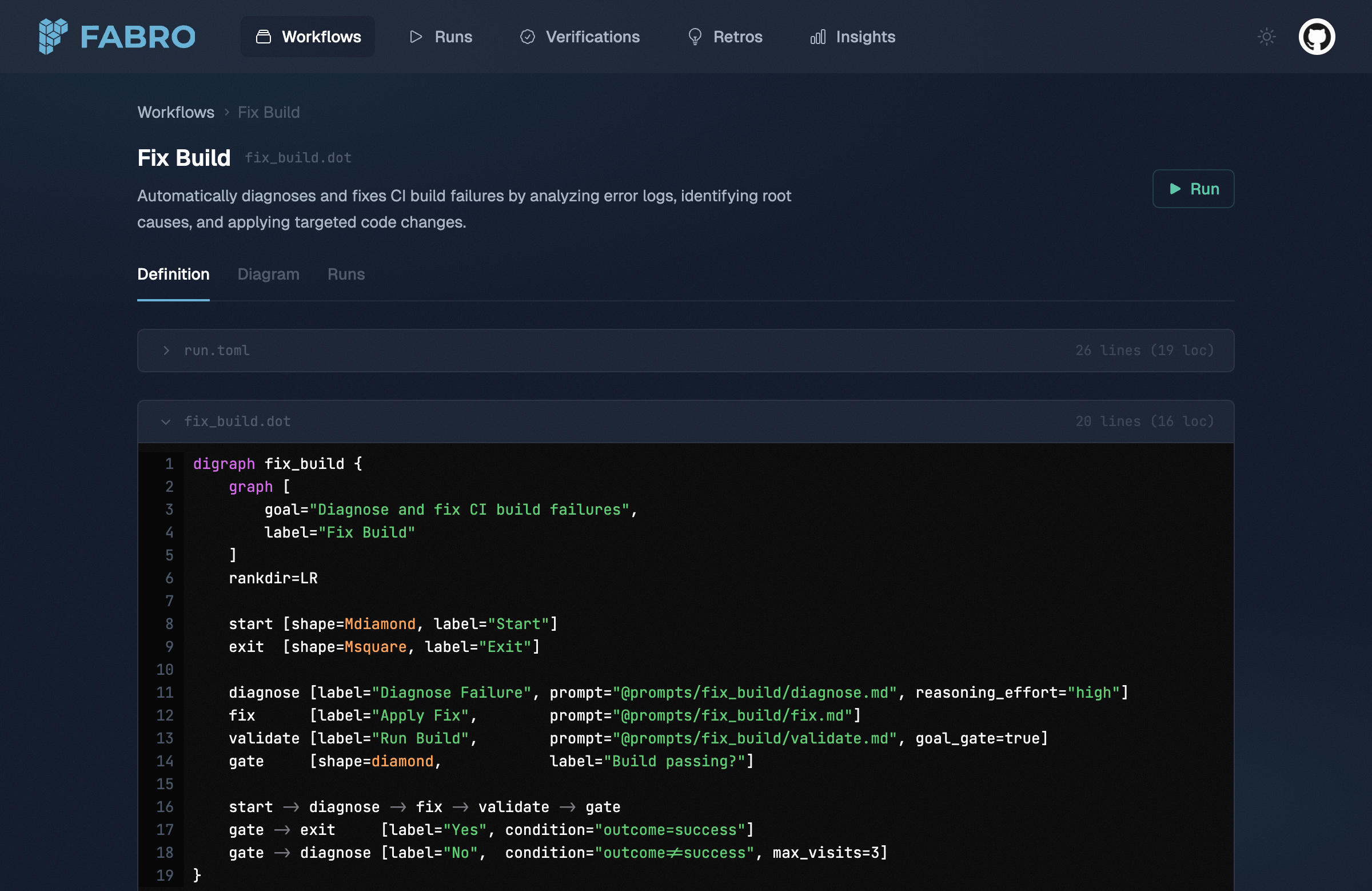
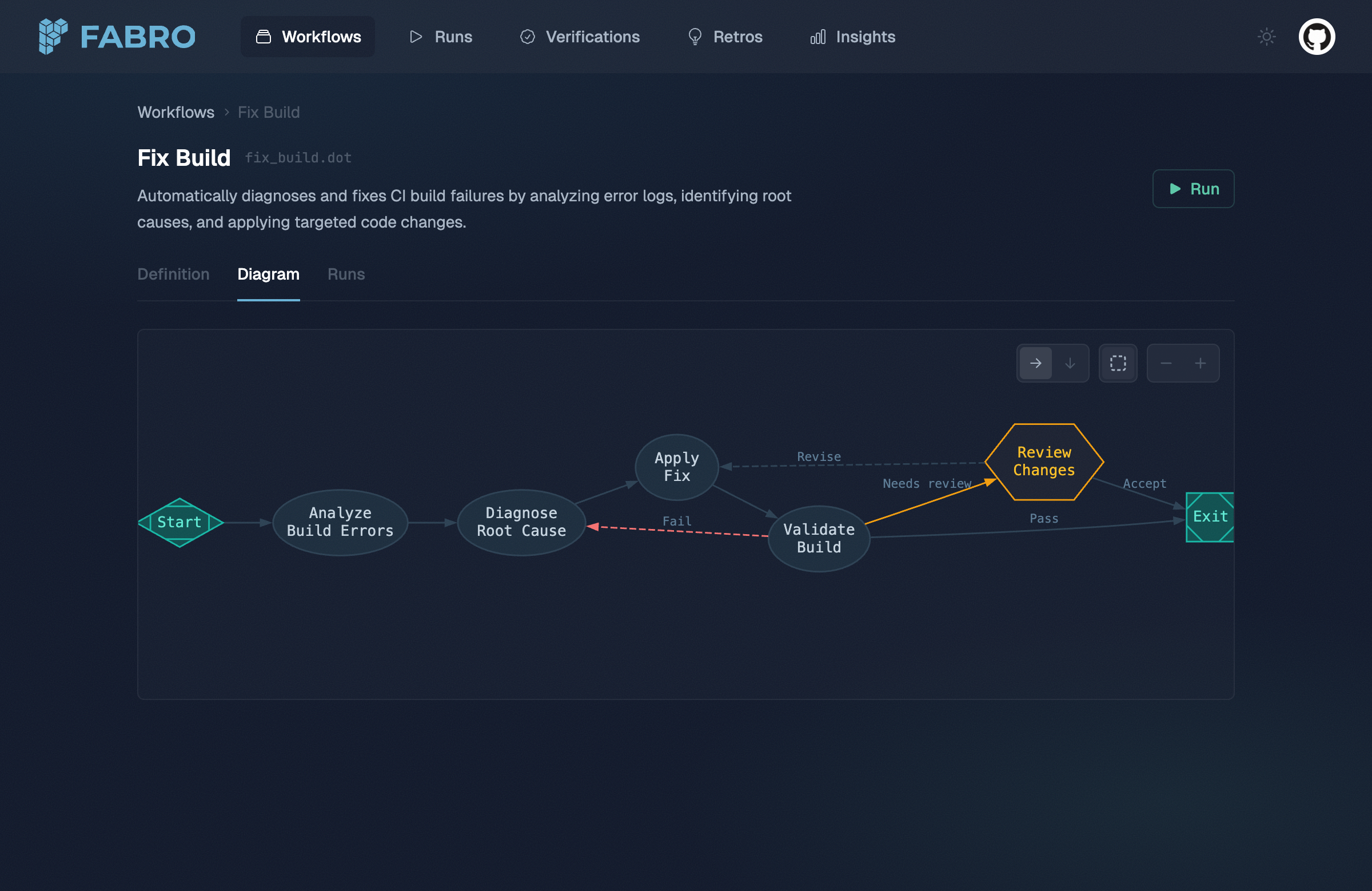
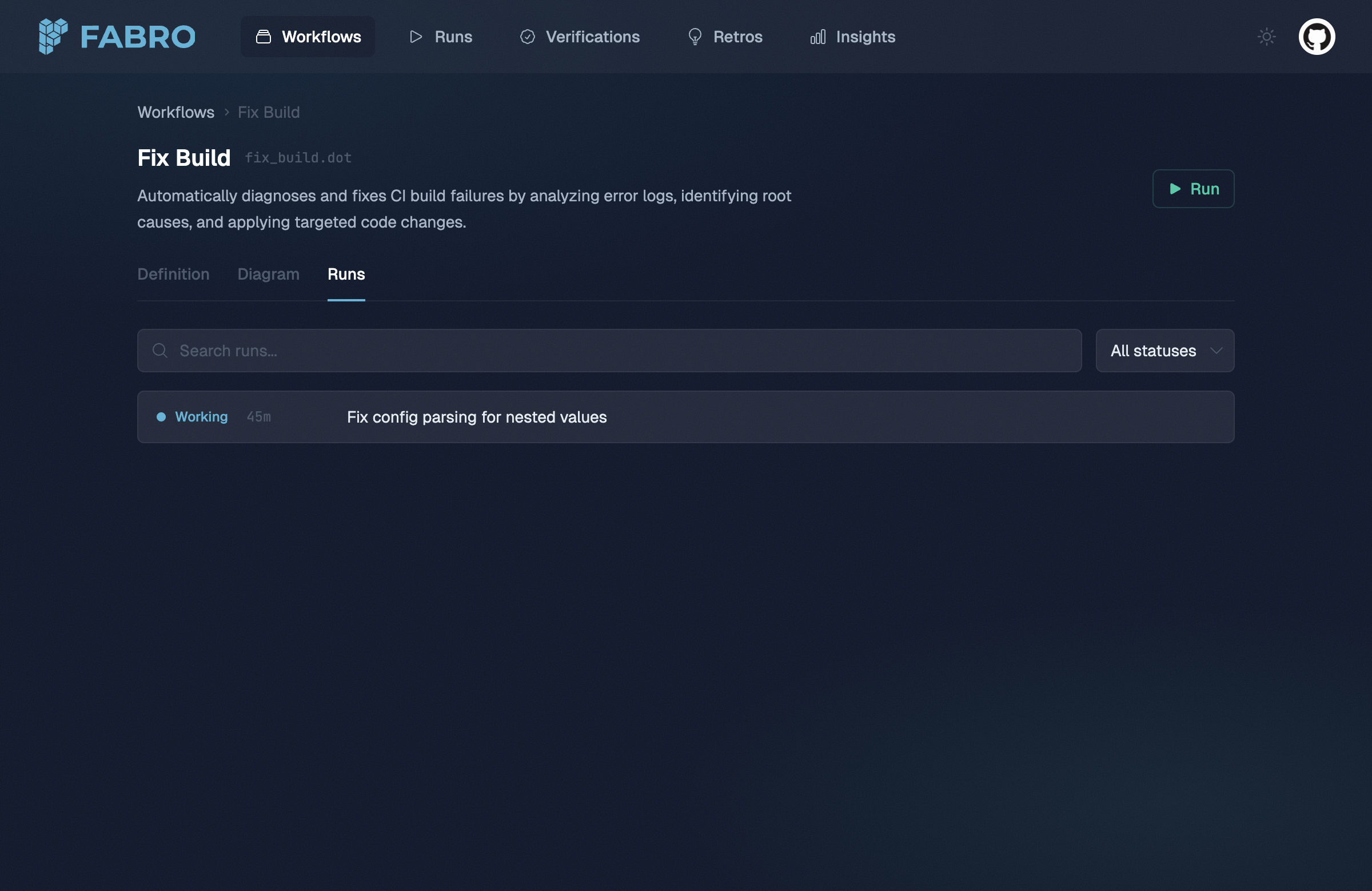
In the web UI, the Workflows page lists all available workflows. Click into a workflow to view its Graphviz definition, rendered graph diagram, and run history.
Fan out to run branches concurrently, then merge the results:
```dot theme={"languages":{"custom":["/languages/dot.json","/languages/fabro.json"]}}
fork [label="Fan Out", shape=component]
merge [label="Merge", shape=tripleoctagon]
fork -> security
fork -> architecture
fork -> quality
security -> merge
architecture -> merge
quality -> merge
merge -> report -> exit
```
## Goal gates
Mark critical nodes with `goal_gate=true`. The workflow fails if any goal gate doesn't succeed — even if execution reaches the exit node:
```dot theme={"languages":{"custom":["/languages/dot.json","/languages/fabro.json"]}}
validate [label="Validate", prompt="Run the test suite and verify all tests pass.", goal_gate=true]
```
## Running a workflow
From the CLI:
```bash theme={"languages":{"custom":["/languages/dot.json","/languages/fabro.json"]}}
fabro run workflow.fabro
```
Or from a [run config TOML](/execution/run-configuration) for repeatable, parameterized runs:
```bash theme={"languages":{"custom":["/languages/dot.json","/languages/fabro.json"]}}
fabro run run.toml
```
In the web UI, the Workflows page lists all available workflows. Click into a workflow to view its Graphviz definition, rendered graph diagram, and run history.
 See the [Quick Start](/getting-started/quick-start) to try it out, or browse the [example workflows](/examples/repl-handoff) for real-world patterns.